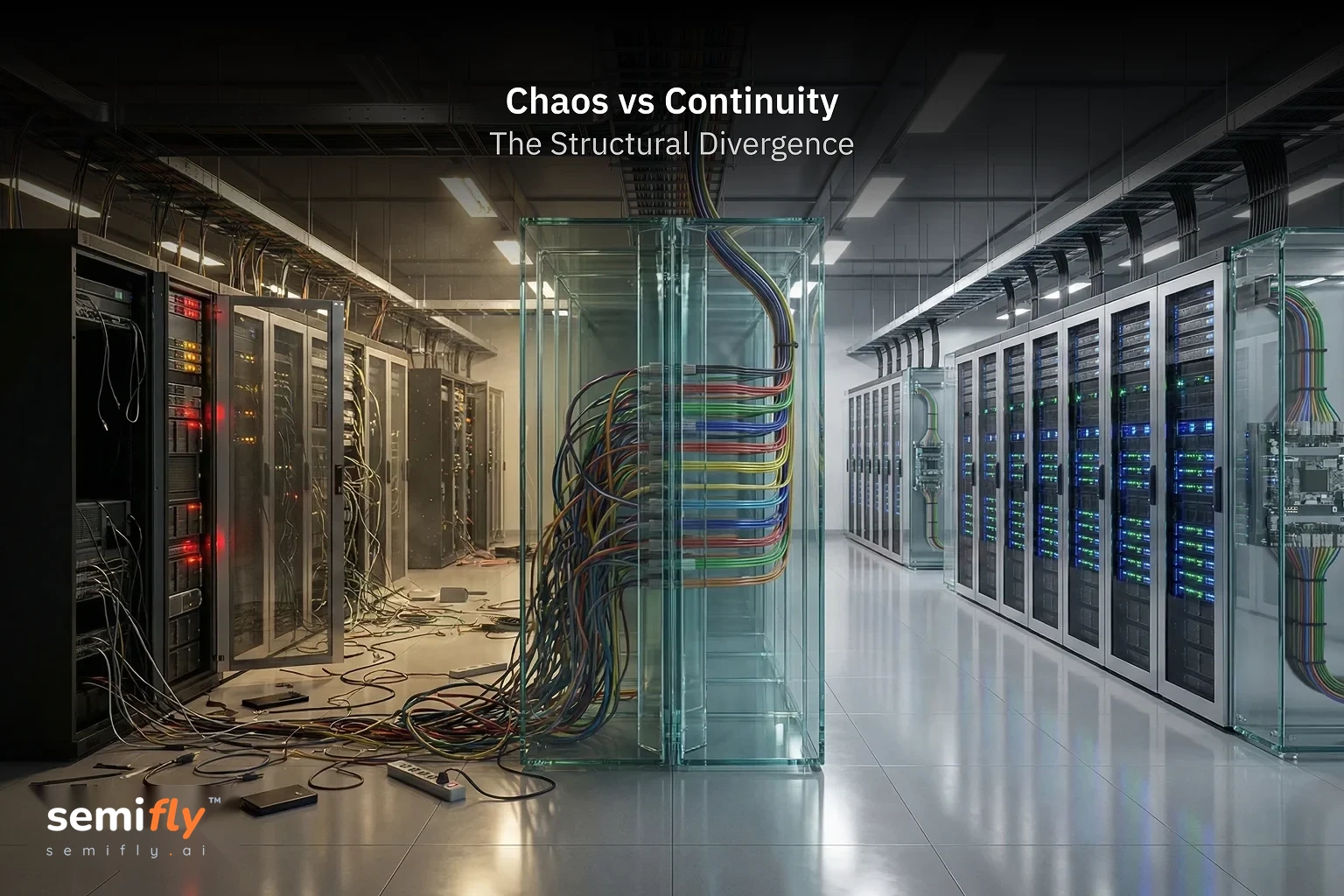

The standard enterprise complaint is that compliance slows innovation; the standard regulator response is that innovation keeps inventing new things to leak. Both sides are describing the same root cause: estates where compliance is a manual layer painted on after the fact. In well-designed clouds the conflict largely dissolves—controls are encoded, evidence accumulates automatically, and new regulations land as policy updates rather than remediation programs.
Key Takeaways
- Compliance-as-code turns obligations into enforced configuration: encrypted-by-default, logged-by-default, deniable-by-policy.
- Data residency and classification are architecture inputs—decide where data may live before workloads scatter it.
- Continuous evidence beats annual archaeology: the audit becomes a query against records that already exist.
- Regulatory change is a constant; estates designed for policy agility absorb it as configuration, not crisis.
01Encode the obligations
Every major compliance regime—GDPR, HIPAA, PCI DSS, SOC 2, and the sector rules layered on top—decomposes mostly into controls a cloud platform can enforce mechanically: encryption at rest and in transit, access least-privilege with review trails, logging with retention, segregation of environments, and residency boundaries. Compliance-as-code expresses those as preventive policies and conformance rules. The result is a quiet inversion: instead of auditing for violations, the platform refuses to create them.
02Architect for data gravity and residency
Innovation scatters data—analytics copies, AI training sets, SaaS integrations—and every copy inherits obligations. Future-proof estates treat classification and residency as first-class architecture: data tagged at creation, storage and processing pinned to approved regions by policy, cross-border flows explicit and documented, and AI/analytics pipelines consuming governed copies rather than ungoverned exports. This is dramatically cheaper to build in than to discover during a regulator's questionnaire.

03Evidence as a continuous byproduct
- Configuration history: conformance tooling records the state of every control, continuously—point-in-time screenshots become obsolete.
- Access reviews from the identity plane: entitlement reports generated quarterly from the system of record, not reconstructed from memory.
- Pipeline attestation: deployments that carry their approvals, scans, and policy checks with them.
- The audit experience: auditors sample a live evidence base; the fire drill quietly disappears from the calendar.
04Design for the next regulation
The regulatory trendline is reliably upward—AI governance, breach-notification tightening, sector data rules. Estates survive that trendline when policy is centralized (one place to add a control), tagging is universal (new rules can find their subjects), and architecture documents itself. Organizations with that posture read new regulation as a configuration diff. Organizations without it read it as a program, a budget, and a year.
05The strategic frame
Compliance done as paint is a tax on every innovation; compliance done as platform is a license for it. Teams ship faster inside guardrails they trust, auditors leave sooner, and the legal function stops being a roadblock and becomes a configuration reviewer. That is what future-proofing actually purchases: the ability to say yes to the next opportunity—and the next regulation—without rebuilding either time.
Ready to put this into practice?
Talk to the Semifly team about your infrastructure, security, and compliance roadmap.
Contact Us