
SemiflyContact
FEATURED STORY OF THE WEEK

H200 GPU Memory Bandwidth: Unlocking the 4.8 TB/s Advantage for AI at Scale

Written by :  
semifly
Team Semifly
4 minute read
September 18, 2025
Category : Artificial Intelligence
H200 GPU Memory Bandwidth: Unlocking the 4.8 TB/s Advantage for AI at Scale

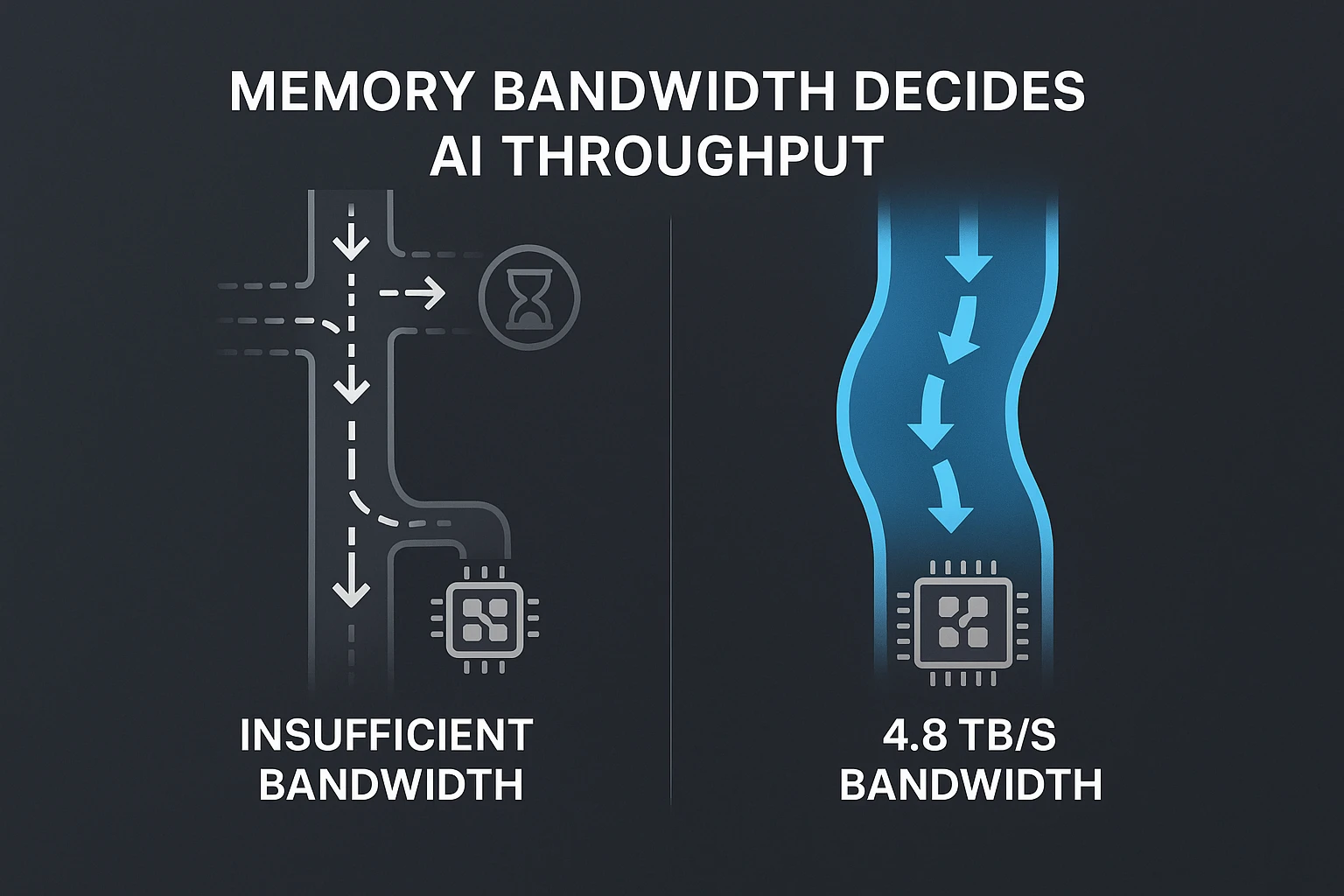
Introduction: Why Memory Bandwidth Decides AI Throughput


In AI infrastructure, raw compute often gets the headlines — FLOPs, core counts, and tensor throughput. But for real-world workloads, especially large language models (LLMs) and generative AI, memory bandwidth decides whether your cluster cruises or crawls.


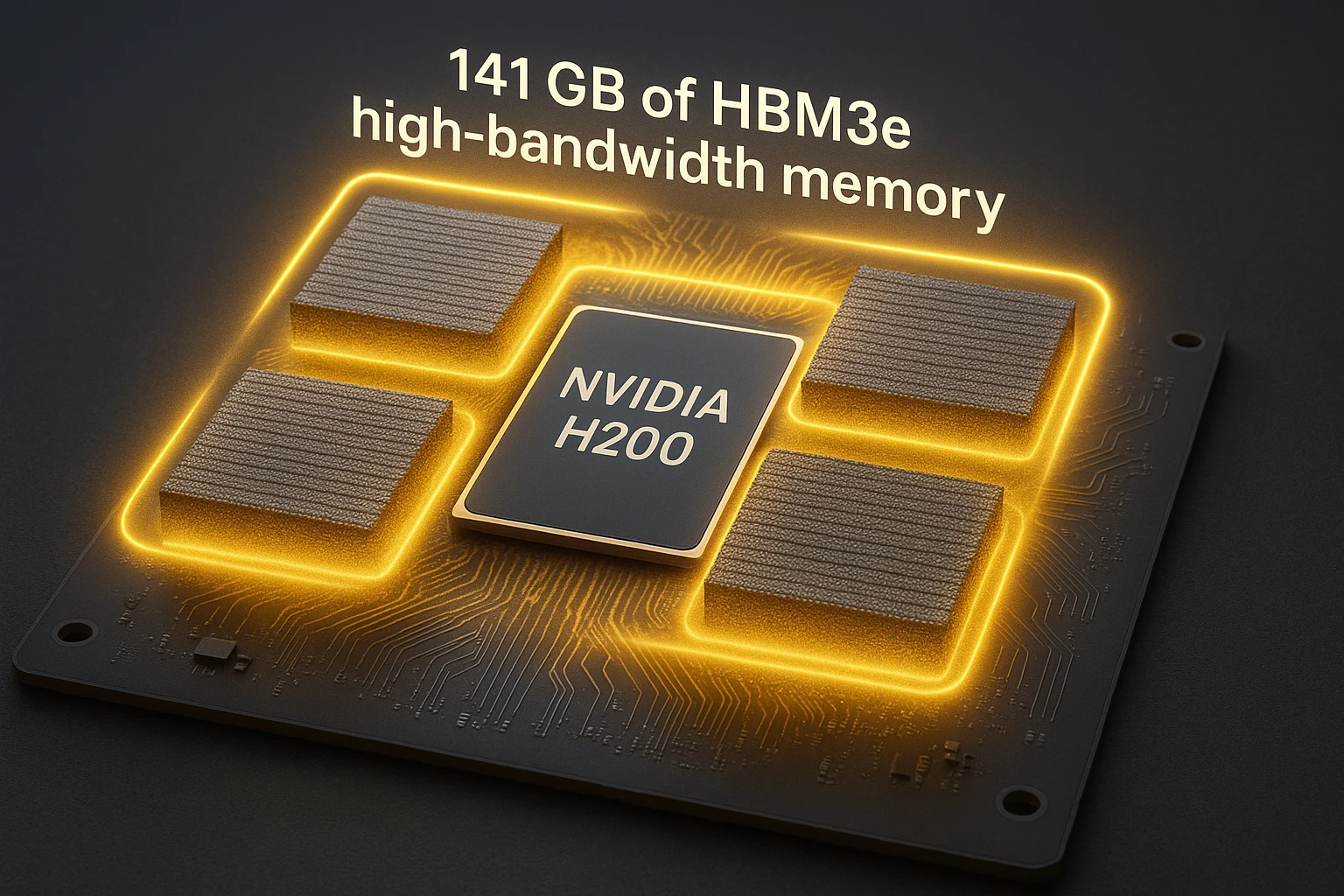
The NVIDIA H200 raises the stakes with a 4.8 terabytes per second (TB/s) memory bandwidth powered by next-generation HBM3e. This isn’t just a spec sheet brag — it’s a redesign of how models can be fed data fast enough to keep 141 GB of high-bandwidth memory and Tensor Cores saturated.


For enterprises deploying AI at scale, understanding how to leverage H200 GPU memory bandwidth is the difference between underutilized silicon and production-grade throughput.


The Anatomy of H200’s 4.8 TB/s Bandwidth


HBM3e: The Physical Backbone


The H200’s memory subsystem is built on 141 GB of HBM3e, offering a 76% increase in capacity over H100’s HBM3 and a substantial jump in peak throughput. HBM3e achieves this by:


  • Higher per-stack transfer rates (up to ~9.2 Gbps per pin)
  • Wider interfaces for multi-stack parallelism
  • Reduced latency under concurrent access


This means your training and inference pipelines can process larger batches and longer sequence lengths without offloading to slower DDR or PCIe-attached memory.


Feeding the Tensor Cores Without Stalls


The 4.8 TB/s bandwidth ensures continuous data delivery to the Hopper architecture’s FP8/FP16/BF16 Tensor Cores. Without this throughput, tensor operations stall, wasting clock cycles and inflating time-to-convergence.


For example:
 

  • FP8 pretraining on a 70B parameter model requires ~2.2 TB/s sustained bandwidth for optimal parallel scaling.
  • H200’s 4.8 TB/s means it can feed multiple GPUs in NVLink/NVSwitch topologies without starving cores.


tailed diagram of NVIDIA H200 GPU highlighting its 141GB HBM3e memory stacks, crucial for 4.8 TB/s bandwidth


Why Memory Bandwidth Matters More for Today’s Workloads


  • LLMs with Longer Context Windows
    New generation models push 8K–32K token contexts, multiplying memory fetch demands per forward pass.
  • Multi-Modal AI
    Models combining text, vision, and speech consume heterogeneous data streams that must be loaded in parallel.
  • Retrieval-Augmented Generation (RAG)
    RAG pipelines pull large chunks of embeddings or document vectors into GPU memory mid-inference, stressing bandwidth in unpredictable bursts.
  • Fine-Tuning with Large Batches
    Methods like LoRA/QLoRA may reduce parameter updates, but bandwidth still gates how quickly activations move through the stack.


Architecting for the 4.8 TB/s Advantage


Semifly helps enterprises build H200-optimized pipelines that actually exploit this bandwidth ceiling. Without the right architecture, real-world throughput may land far below spec.


Key Design Principles:


  • Model Parallelism Alignment — Pin tensor and pipeline parallel partitions to minimize cross-node memory hops.
  • NVLink/NVSwitch-Aware Topologies — Maximize intra-node bandwidth before crossing to inter-node links.
  • Prefetching & Streaming Data Loaders — Overlap I/O with compute so Tensor Cores never idle.
  • Mixed Precision with Transformer Engine — FP8 reduces memory footprint and accelerates transfers without accuracy collapse.


Common Bandwidth Bottlenecks We See


Even with H200’s bandwidth, poorly tuned stacks lose performance to:


  • PCIe oversubscription when staging datasets
  • Non-RDMA network fabrics choking multi-node training
  • Container stack mismatches (CUDA/NCCL) that disable GPUDirect paths
  • Inefficient checkpointing that floods I/O mid-training


This is why Semifly’s pre-flight validation includes I/O flooding tests — simulating simultaneous NVLink, PCIe, and NIC loads to ensure no choke points remain before launch.
 

Real-World Impact of Optimizing H200 GPU Memory Bandwidth


Real-World Impact of Optimizing H200 GPU Memory Bandwidth


From Semifly’s recent deployments:


Component Semifly’s Offering
AI Hardware NVIDIA H200 (PCIe or SXM), DGX/HGX systems
Isolation MIG slicing, confidential compute (TEE)
Custom Orchestration Terraform, Kubernetes, Slurm for secure AI deployment
Compliance Templates Aligned with GDPR, HIPAA, EU AI Act, IndiaDP, and others
Model Compatibility Hugging Face, Mistral, LLaMa2, BLOOM, regional LLMs


The takeaway: H200’s 4.8 TB/s isn’t just theoretical — it directly compresses training timelines and inference latency when harnessed correctly.


Semifly’s Role in Maximizing H200 Bandwidth


When we design for H200 GPU memory bandwidth, we don’t stop at hardware specs. We:


  • Map model graph execution to memory topology
  • Optimize network fabrics for GPUDirect RDMA
  • Benchmark memory-bound kernels under production loads
  • Deliver baseline-to-optimized performance reports


This means your investment in H200 delivers peak real-world throughput from day one.


Final Take: Bandwidth Is the New Battleground


In AI compute, teraflops set the potential, but terabytes per second decide the outcome. The NVIDIA H200’s 4.8 TB/s GPU memory bandwidth is a leap forward, but only if your architecture, data pipeline, and orchestration stack are ready to exploit it.


With Semifly’s architecture-first approach, your H200 deployment won’t just have the spec — it will have the speed, efficiency, and resilience to keep up with the AI workloads of 2025 and beyond.

 

Bookmark me
Share on
Comments
Add your Comment

Explore Nvidia’s GPUs

Find a perfect GPU for your company etc etc
Go to Shop

FAQs

  • The NVIDIA H200 GPU features a remarkable 4.8 terabytes per second (TB/s) memory bandwidth, powered by next-generation HBM3e technology. While raw compute power (FLOPs, core counts) often garners attention in AI infrastructure, for demanding workloads like large language models (LLMs) and generative AI, memory bandwidth is the critical factor determining overall throughput and efficiency. This high bandwidth ensures that the GPU’s Tensor Cores are continuously supplied with data, preventing stalls and maximising utilisation. Without sufficient memory bandwidth, even powerful processing units would be underutilised, leading to slower training times and increased operational costs.

  • The H200’s 4.8 TB/s memory bandwidth is fundamentally built upon 141 GB of HBM3e (High-Bandwidth Memory 3e). HBM3e offers a 76% increase in memory capacity over its predecessor, HBM3, and a significant boost in peak throughput. This is achieved through several advancements: higher per-stack transfer rates (up to approximately 9.2 Gbps per pin), wider interfaces that enable multi-stack parallelism, and reduced latency when memory is accessed concurrently. These improvements allow the H200 to process larger data batches and longer sequence lengths without having to offload data to slower, external memory like DDR or PCIe-attached memory.

  • High memory bandwidth is more important than ever for today’s advanced AI workloads due to several factors:


    • Large Language Models (LLMs) with Longer Context Windows: Newer LLMs frequently process context windows of 8K to 32K tokens, which significantly increases the memory fetch demands for each forward pass.
    • Multi-Modal AI: Models that integrate different data types like text, vision, and speech require heterogeneous data streams to be loaded simultaneously, putting a substantial strain on memory bandwidth.
    • Retrieval-Augmented Generation (RAG): RAG pipelines dynamically pull large embedding chunks or document vectors into GPU memory during inference, causing unpredictable bursts in bandwidth demand.
    • Fine-Tuning with Large Batches: Even methods that reduce parameter updates, such as LoRA/QLoRA, are still gated by how quickly activations can move through the memory stack.
  • To truly exploit the H200’s substantial memory bandwidth, enterprises should adopt specific architectural design principles:


    • Model Parallelism Alignment: Partitioning tensor and pipeline parallel operations in a way that minimises cross-node memory transfers.
    • NVLink/NVSwitch-Aware Topologies: Prioritising and maximising intra-node bandwidth through NVLink and NVSwitch before resorting to inter-node links.
    • Prefetching & Streaming Data Loaders: Implementing mechanisms that overlap I/O operations with computation to ensure the Tensor Cores are always active and never idle.
    • Mixed Precision with Transformer Engine: Utilising FP8 precision to reduce memory footprint and accelerate data transfers without compromising accuracy.
  • Even with the H200’s exceptional memory bandwidth, poorly optimised software stacks and infrastructure can lead to significant performance losses. Common bottlenecks include:

    • PCIe Oversubscription: When staging datasets, the PCIe bus can become a bottleneck if not managed efficiently.
    • Non-RDMA Network Fabrics: Standard network fabrics can choke multi-node training by failing to support Remote Direct Memory Access (RDMA).
    • Container Stack Mismatches: Incompatibilities or misconfigurations in container environments (e.g., CUDA/NCCL versions) can disable GPUDirect paths, which are essential for high-speed data transfer.
    • Inefficient Checkpointing: Poorly implemented checkpointing strategies can flood I/O during mid-training, causing significant delays.
  • Optimising H200 GPU memory bandwidth has a direct and significant impact on AI deployment metrics. According to Semifly’s deployments, optimisations have led to:


    • Sustained GPU Utilisation: Increased from approximately 58% to over 92%.
    • Tokens/sec (70B FP8 Model): Boosted from 210K to 370K.
    • Epoch Time (1 Trillion Tokens): Reduced from 9.8 days to 5.9 days.
    • Power Cost per 1K Tokens: Decreased to 64% of the original cost.

    These results highlight that the H200’s 4.8 TB/s bandwidth, when correctly harnessed, directly shortens training timelines and improves inference latency, leading to substantial efficiency gains and cost reductions.

  • Semifly employs an “architecture-first” approach to ensure that H200 deployments achieve peak real-world throughput. Their services go beyond mere hardware specifications and include:


    • Mapping Model Graph Execution to Memory Topology: Aligning how the AI model processes data with the physical memory layout to minimise bottlenecks.
    • Optimising Network Fabrics for GPUDirect RDMA: Ensuring that the network infrastructure supports high-speed, direct data transfer between GPUs.
    • Benchmarking Memory-Bound Kernels Under Production Loads: Testing and refining performance for operations that are heavily dependent on memory bandwidth in real-world conditions.
    • Delivering Baseline-to-Optimised Performance Reports: Providing clear data on performance improvements achieved through their optimisations.


    This comprehensive approach aims to ensure that the investment in H200 GPUs delivers its maximum potential from the outset.

  • While teraflops indicate the theoretical processing potential of an AI system, “terabytes per second” (memory bandwidth) is increasingly the determinant of actual performance and outcome in real-world AI applications. The NVIDIA H200’s 4.8 TB/s GPU memory bandwidth represents a significant technological advancement. However, this leap forward is only effective if the underlying architecture, data pipelines, and orchestration stack are specifically designed and ready to fully exploit it. The ability to efficiently feed data to the powerful Tensor Cores without interruption is now the critical factor differentiating high-performing, resilient AI deployments from underutilised systems, making memory bandwidth the pivotal area for innovation and optimisation in AI infrastructure for the future.

semifly
About Us