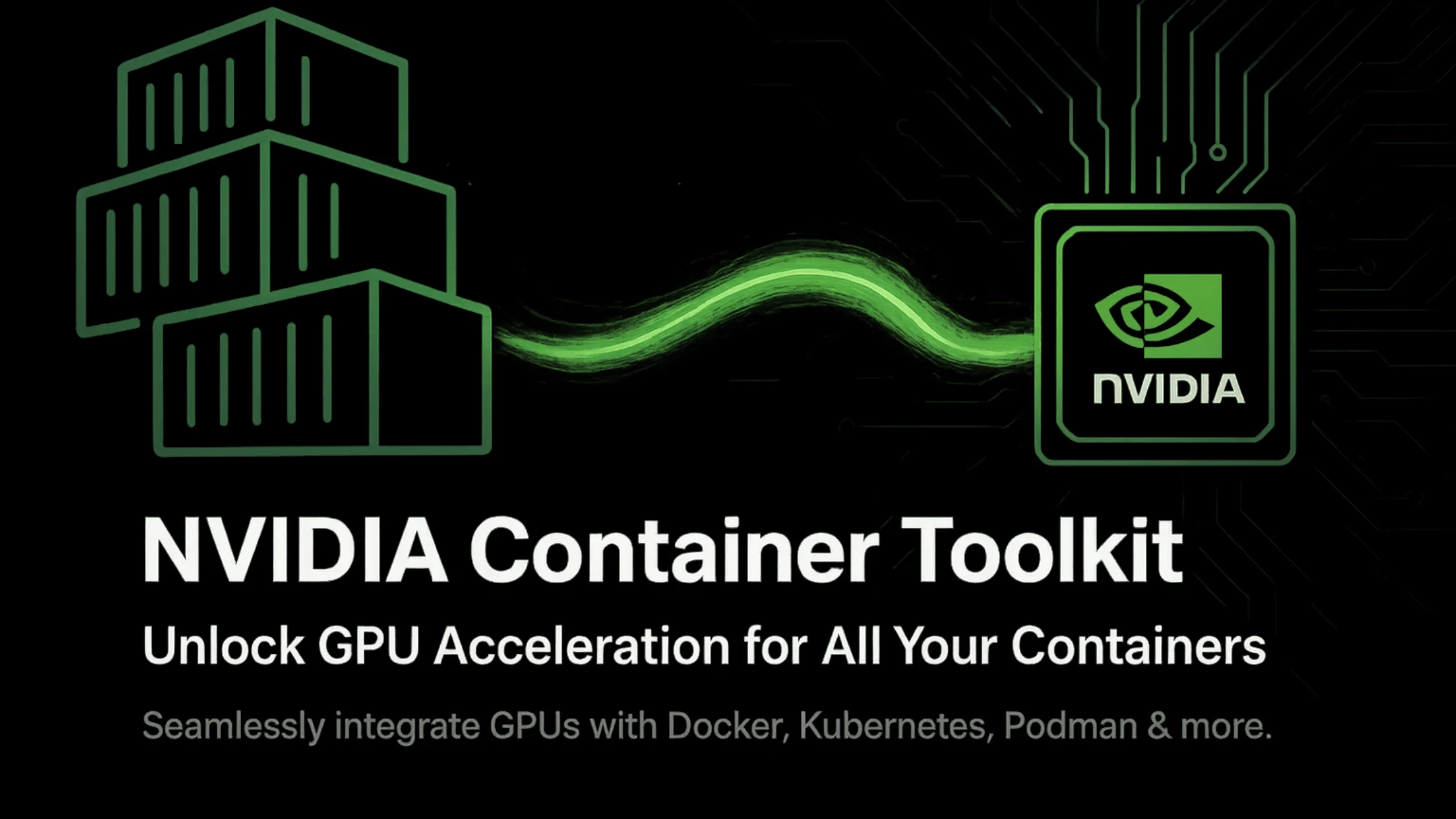
Containers won the packaging war everywhere except, for a long time, the GPU. Devices, kernel drivers, and a userspace that must match them—none of it fits the “ship the whole environment” promise naturally. The NVIDIA Container Toolkit is the piece of plumbing that resolved the mismatch, and understanding what it actually does is the difference between GPU containers that work and GPU fleets that page you.
Key Takeaways
- The toolkit injects GPU devices and the host's driver userspace into containers at runtime—images stay driver-agnostic and portable.
- The contract: driver lives on the host, CUDA toolkit lives in the image, and the two must be version-compatible.
- Kubernetes integration arrives via the device plugin / GPU Operator; MIG and time-slicing make sharing schedulable.
- Most production incidents trace to version drift—pin, baseline, and upgrade hosts and images as one tested unit.
01The problem it solves
A GPU container needs three things the container abstraction does not naturally provide: the device nodes themselves, the driver-matched userspace libraries, and a way to express “this workload gets these GPUs.” Bake driver libraries into the image and it breaks on the next host; mount everything manually and you have invented a fragile, bespoke toolkit. The official one formalizes the handshake: at container start, it injects the devices and the host's driver userspace, so the same image runs on any properly drivered host.
02How the pieces stack
- Host layer: kernel driver and toolkit packages—the only NVIDIA software that belongs on the node itself.
- Runtime layer: integration with containerd/Docker/CRI-O so
--gpus(or resource requests) trigger injection. - Image layer: CUDA toolkit, cuDNN, frameworks—pinned per image, validated against the host driver matrix.
- Orchestration layer: the Kubernetes device plugin advertises GPUs as schedulable resources; the GPU Operator manages the whole host stack as cluster software, which is how fleets stay uniform.
03Production practices that prevent pages
- Pin the matrix: a fleet-wide compatibility table—driver version × CUDA image versions—tested in CI, upgraded as a unit.
- Share deliberately: MIG partitions for hard isolation, time-slicing for dev density—chosen per tier, never by accident.
- Monitor from inside and outside: DCGM on hosts, per-container GPU metrics in your observability stack; utilization invisible is utilization wasted.
- Keep images lean: runtime-only bases for serving, full toolkits only where compilation happens—multi-gigabyte images are pull-time outages waiting for a node scale-up.
04Why it matters strategically
Every serious AI platform pattern—NIM microservices, Triton serving, Kubernetes GPU scheduling, multi-tenant research clusters—assumes this layer works and is boring. Treat the toolkit, driver baseline, and image matrix as one operated artifact with an owner and an upgrade cadence, and GPU containers become infrastructure. Treat them as defaults that ship with the OS, and they become incidents.
Ready to put this into practice?
Talk to the Semifly team about your infrastructure, security, and compliance roadmap.
Contact Us