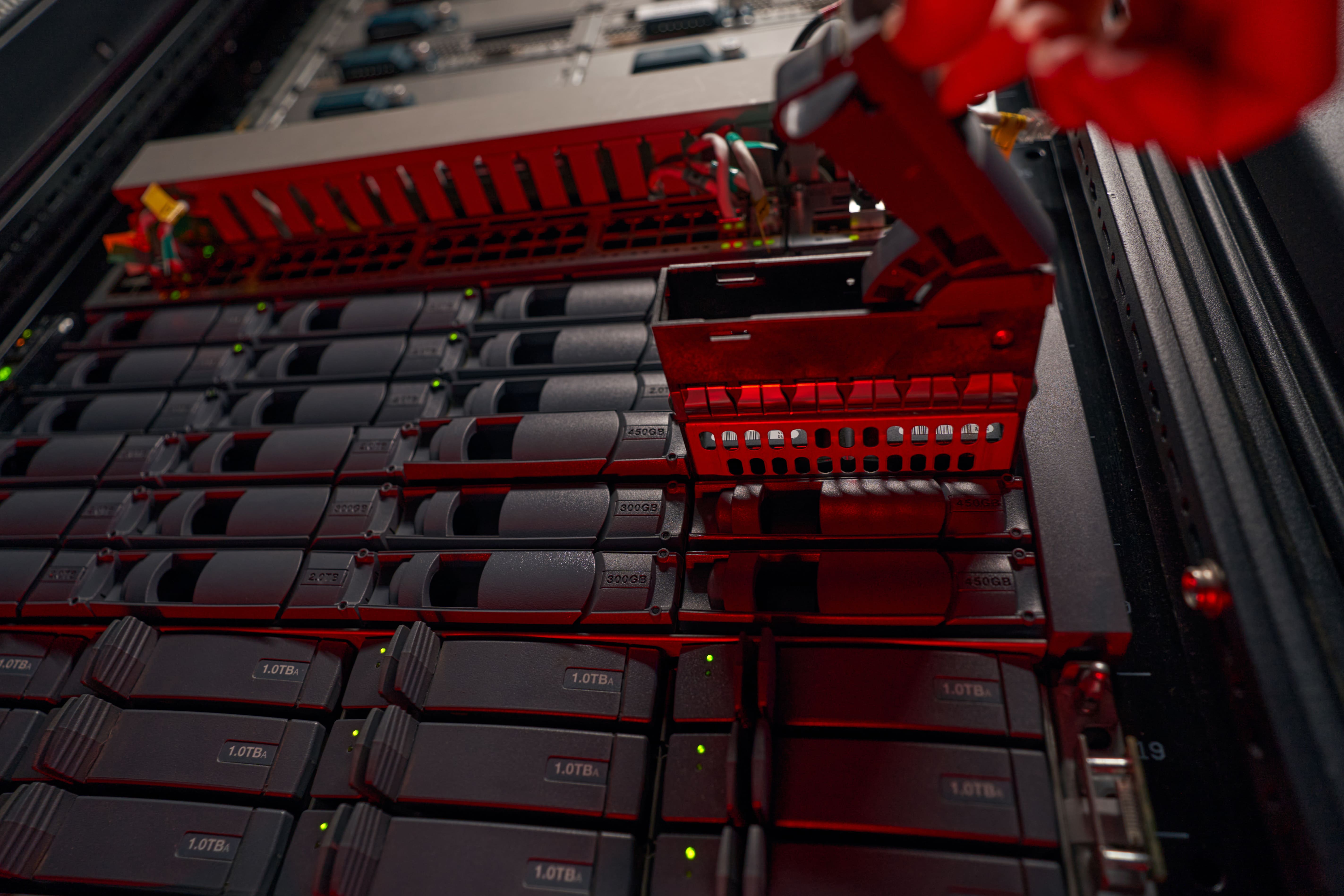

Before every storage problem becomes a SAN purchase, it is worth remembering the oldest pattern in the book: a server, a SAS cable, and a shelf of disks. HPE's D3610 (twelve large-form drives) and D3710 (twenty-five small-form drives) enclosures are that pattern executed properly—dense, dual-pathed, and managed through the same Smart Array tooling ProLiant administrators already know. For a well-defined class of workloads, this is not the budget option; it is the correct one.
Key Takeaways
- D3610 = 12 LFF bays for capacity economics; D3710 = 25 SFF bays for spindle count and IOPS density.
- Direct-attach removes fabric cost and latency—ideal where one server (or an HA pair) owns the data.
- Dual SAS paths and daisy-chaining give resilience and growth without new management planes.
- Right roles: backup targets, video and surveillance, database scratch, dense single-owner capacity.
01The case for staying direct
Shared storage earns its complexity when many hosts need the same data. When they do not—a backup server feeding a tape/cloud tier, a media archive, a database whose storage belongs to it alone—a SAN adds cost, latency, and a skill requirement while subtracting nothing. DAS via 12Gb SAS delivers full-bandwidth, low-latency access with the failure surface of a cable, and the D3000 enclosures add the enterprise trims that distinguish them from a JBOD gamble: redundant I/O modules and power, hot-plug everything, and firmware that lives inside HPE's normal lifecycle tooling.
02Choosing between the two
- D3610 (12×LFF): the capacity play—large NL-SAS drives for backup repositories, surveillance retention, archives, and bulk file. Terabytes-per-dollar is the metric; sequential throughput is the strength.
- D3710 (25×SFF): the spindle play—more, smaller drives (including SSD mixes) for IOPS-sensitive roles: database volumes, dedupe-heavy backup targets, and mixed workloads where parallelism beats raw capacity.
- Both: daisy-chain to grow, dual-domain cabling for path resilience, Smart Array RAID/caching policies tuned per role.

03Design notes from the field
Three practices keep DAS deployments healthy at year five: cable and label both paths from day one (the redundancy you did not cable is decoration); match RAID geometry to the workload (wide RAID6 for capacity tiers, smaller groups or RAID10 for IOPS roles) and budget rebuild times for large drives honestly; and keep enclosure firmware in the same patch cadence as the host—orphaned firmware is where weird I/O errors are born. Sized and operated this way, the D3610/D3710 pair covers an enormous share of real-world storage demand at a fraction of fabric cost—which is why, decades into the SAN era, the SAS shelf remains quietly indispensable.
Ready to put this into practice?
Talk to the Semifly team about your infrastructure, security, and compliance roadmap.
Contact Us