
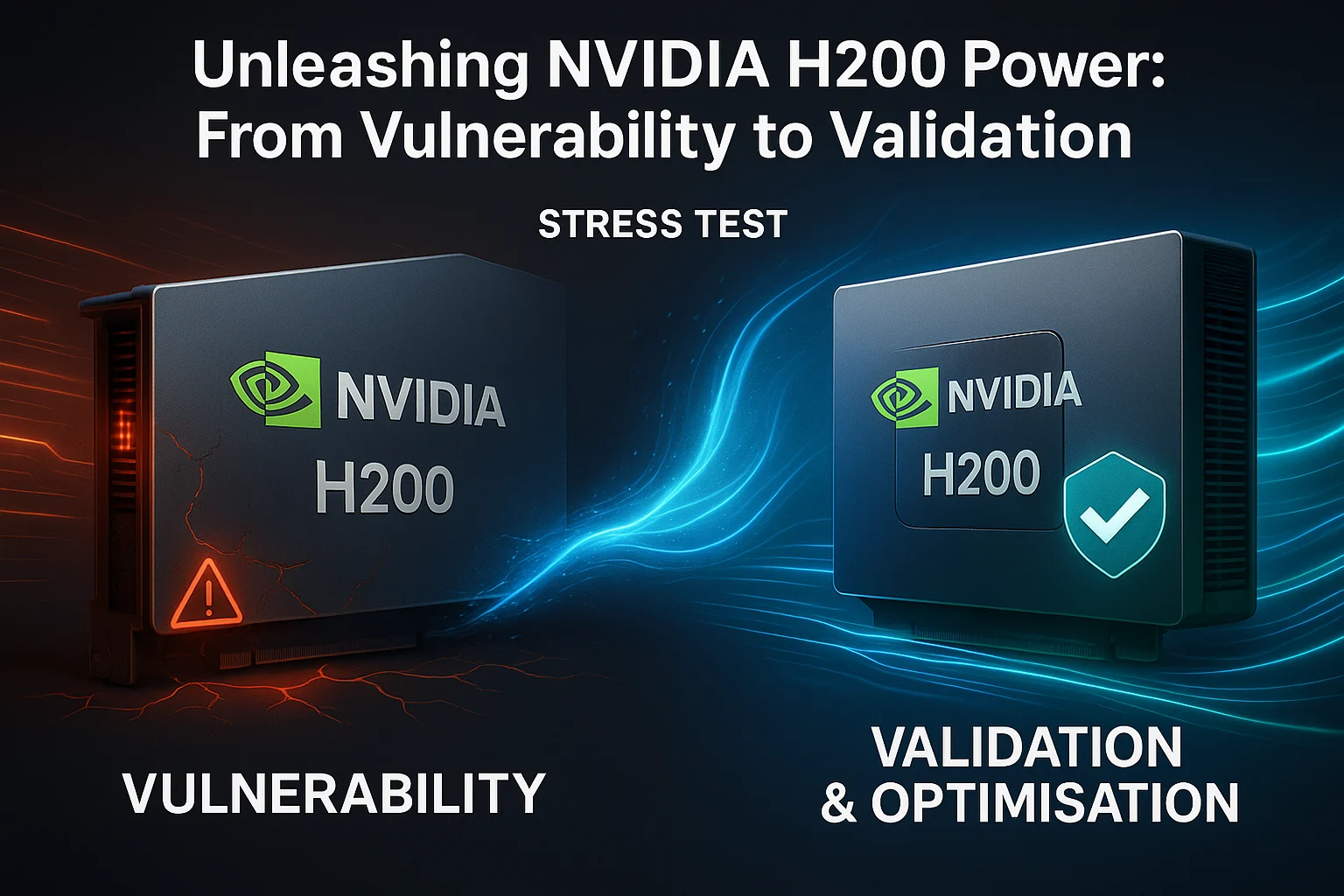
An H200 server that fails during week one of a training run does not just cost you a support ticket. It costs the run itself—checkpoint rollbacks, idle cluster time across every healthy node waiting on the replacement, and engineering hours spent on forensics instead of models. On a large cluster, a single flaky node can quietly degrade collective-communication performance for the entire job long before it fails outright.
That is why serious AI infrastructure teams treat deployment like aviation treats a new aircraft: nothing carries production workloads until it has passed a pre-flight stress test. This article describes what that test should cover for an H200 fleet, why each subsystem earns its place in the protocol, and the acceptance gate worth writing into your deployment runbook.
Key Takeaways
- Hardware failures cluster in early life; a structured burn-in compresses that period into a controlled window before production.
- Four subsystems deserve dedicated stress coverage: thermals/power, the HBM3e memory subsystem, interconnect, and the software stack as a unit.
- Full-fleet simultaneous load—not card-by-card testing—is what exposes the failures that matter at scale.
- Baseline numbers captured at burn-in become your degradation reference for the life of the fleet.
01Why new silicon needs a burn-in
Hardware failures follow the bathtub curve: defects cluster in early life, flatten for years, then rise again with age. The purpose of a burn-in is to compress that early-failure period into a controlled window—before your workloads arrive, while swaps are cheap and nobody's training run is at stake.
The H200 raises the stakes on this old discipline. Its HBM3e stacks push memory bandwidth into territory that stresses signal integrity and error correction harder than previous generations; its thermal envelope is dense enough that marginal cooling shows up as silent throttling rather than clean failure. The components under the most stress are precisely the ones a casual smoke test never exercises.
02The four subsystems that matter
1. Thermals and power
Run sustained full-load stress across all GPUs simultaneously—not one at a time—for at least 48 hours. Card-by-card testing validates cards; fleet-wide testing validates the installation. You are looking for thermal throttling under realistic airflow, power-delivery sag when every card peaks together, and fan curves that hold up in your actual rack with your actual blanking panels, not the vendor's lab.
A node that throttles quietly is worse than one that fails loudly: in distributed training, the slowest participant sets the pace for every all-reduce, and a 5% thermal degradation on one node taxes the whole cluster in ways that are miserable to diagnose six weeks later.
2. Memory integrity
Test the memory subsystem like you mean it: full-capacity allocation sweeps, bandwidth benchmarks compared against the published envelope, and ECC error monitoring running throughout the entire burn-in. Record everything.
Corrected errors are not failures—that is what the correction is for—but a card that corrects noticeably more than its fleet-mates during burn-in is statistically the card that pages you at 3 a.m. in month four. Early-life replacement under warranty is free. Mid-run replacement never is.
3. Interconnect
Validate NVLink topology and bandwidth between every GPU pair within each node, then do the same across nodes for your fabric—InfiniBand or RoCE—under the all-reduce and all-to-all traffic patterns that mimic distributed training. Run the collective-communication benchmarks at full scale, not on a sample.
Full-scale fabric testing finds the marginal cable, the misseated transceiver, the switch port negotiating below line rate, the subtly asymmetric topology that makes one rack consistently slower. It always finds something. Finding it during burn-in costs an afternoon; finding it during production costs a war room.
4. The software stack as one unit
Pin and validate the full stack—driver, CUDA, NCCL, container runtime, orchestration—as a single tested combination, because that combination is what production actually runs. Then go beyond synthetic benchmarks: run a short real training job with checkpointing enabled, kill a node on purpose, and confirm the job recovers cleanly from the checkpoint.
A fleet that passes synthetic benchmarks but has never executed a checkpoint restore under failure is not production-ready; it is production-hopeful.
03The acceptance gate
Write the gate into the runbook and make it binary—a node either passes or it does not carry workloads:
- 48–72 hours sustained full-fleet load with zero thermal throttling and stable clocks on every card
- Memory bandwidth within tolerance of spec on every card; zero uncorrected ECC errors; corrected-error rates consistent across the fleet
- NVLink and fabric bandwidth uniform across all pairs and nodes under collective traffic
- End-to-end training job with checkpoint, deliberate failure injection, and clean recovery
- Baseline metrics captured and archived for every node
04The cheapest insurance in AI infrastructure
Document the baseline numbers—bandwidth per card, error rates, sustained clocks, fabric latency—because they become your reference for detecting degradation six months in, when “is this node slower than it used to be?” is otherwise unanswerable. The pre-flight protocol typically costs three to five days per deployment wave. Measured against a single aborted training run on a multi-million-dollar cluster, it is the cheapest insurance in AI infrastructure—and the difference between a deployment and a launch.
Ready to put this into practice?
Talk to the Semifly team about your infrastructure, security, and compliance roadmap.
Contact Us