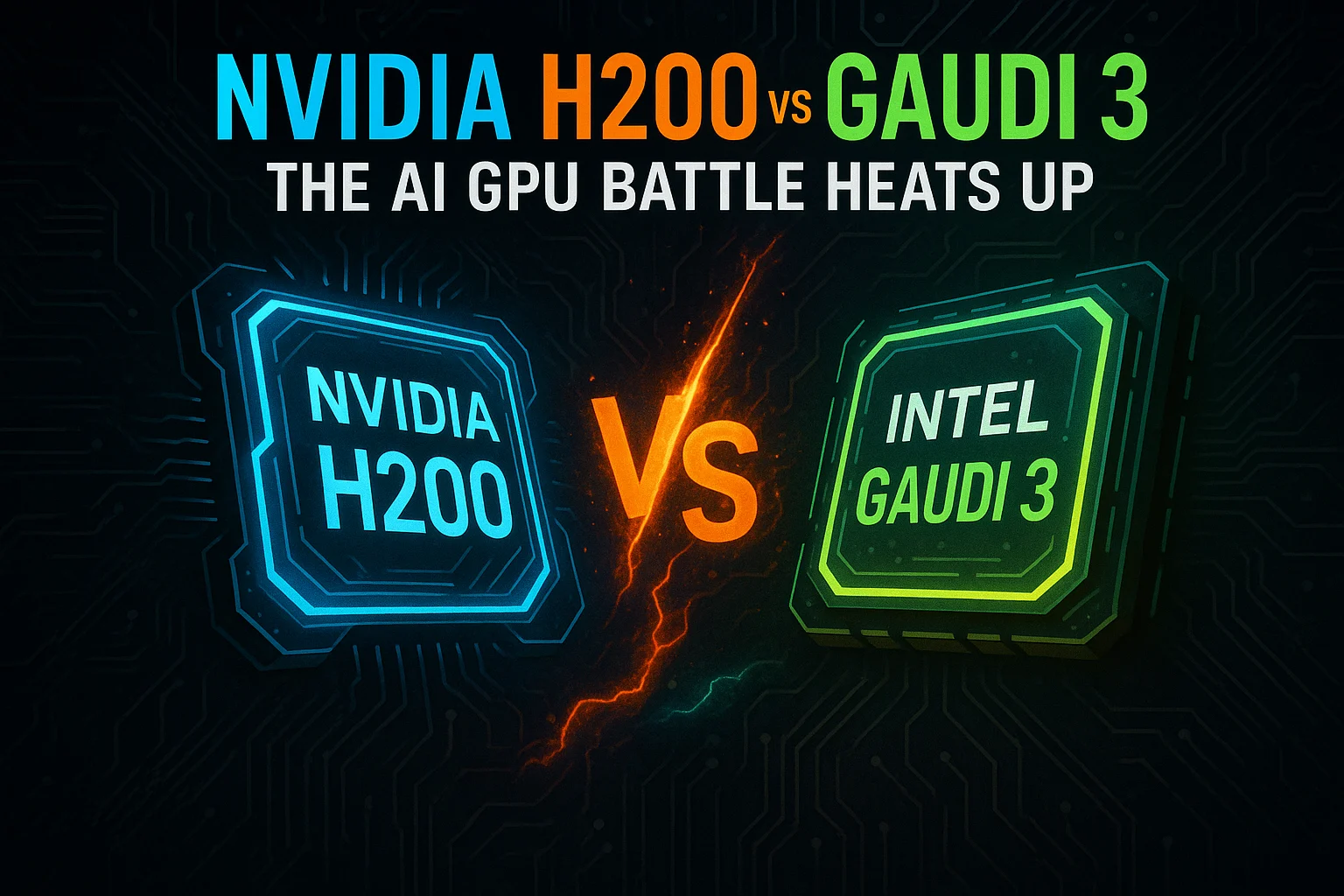
For years the AI accelerator conversation had one default answer. Intel's Gaudi 3 is part of a new wave of serious challengers, and for buyers that competition is good news. Here is how the NVIDIA H200 and Gaudi 3 compare on the dimensions that actually decide deployments.
Key Takeaways
- Benchmark on your models, not vendor reference workloads.
- Weigh total cost of ownership, not just sticker price per chip.
- Account for software maturity and your team's existing skills.
- Consider supply, support, and roadmap alongside performance.
01Raw capability and memory
Both accelerators target large-model training and inference with generous high-bandwidth memory. The H200 leads on memory bandwidth and benefits from a deeply optimized software stack. Gaudi 3 competes aggressively on price-performance and on memory capacity, aiming to lower the cost of entry for large workloads.
02The software question
Hardware specifications rarely tell the whole story. NVIDIA's CUDA ecosystem remains the most mature, with broad framework support and a vast body of optimized kernels — a real advantage for teams that want to move fast. Gaudi's software has improved markedly, and for organizations whose workloads map cleanly onto supported paths, it can deliver strong value.
03The takeaway
Competition is pushing both performance and value forward. The right answer depends on your workloads, your stack, and your budget — not on a single benchmark. Semifly runs side-by-side evaluations on representative workloads so the decision rests on evidence from your environment, not marketing claims.
← Back to Insights