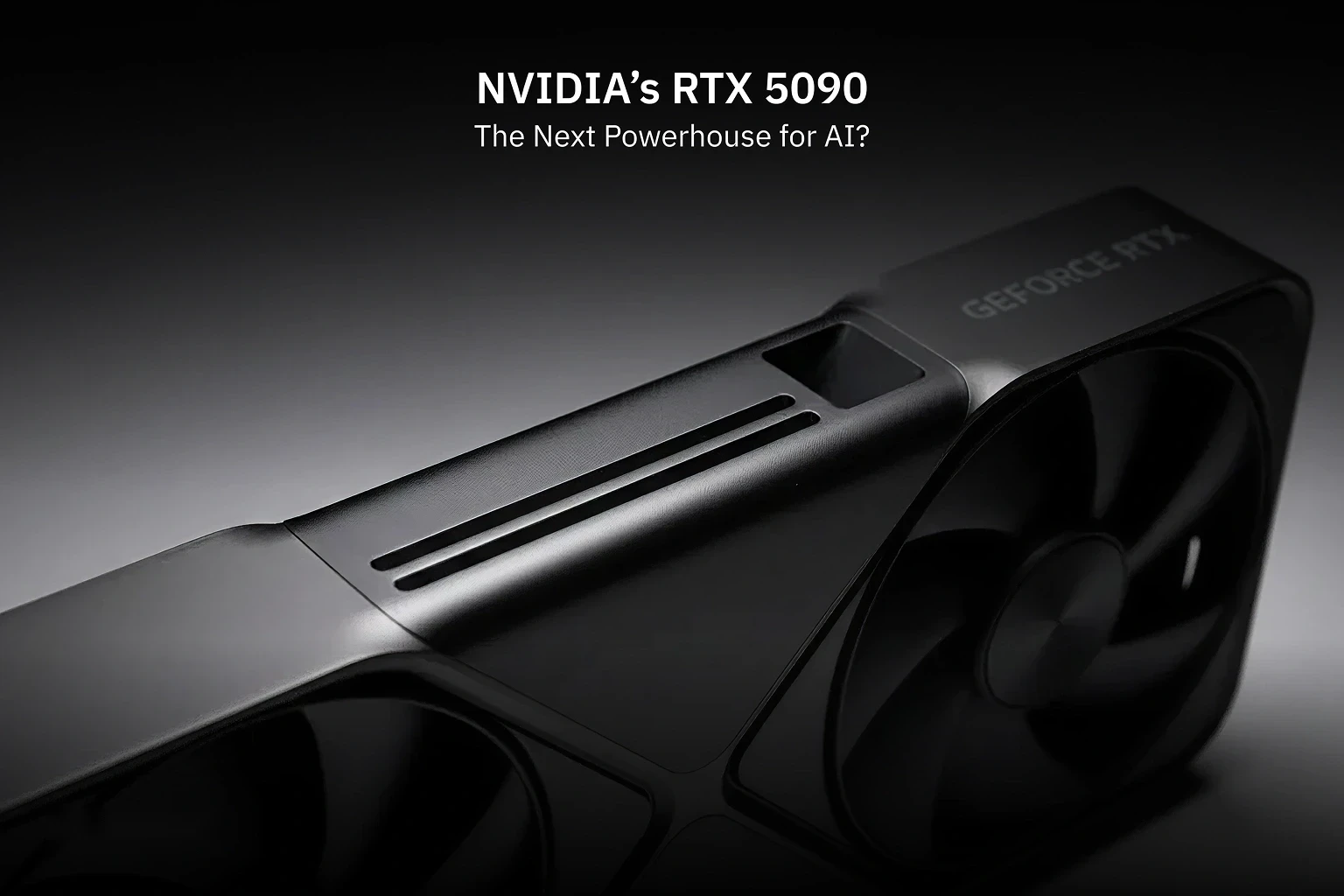
Every GPU generation, one consumer card becomes the unofficial mascot of the AI community. For the Blackwell generation that card is the RTX 5090—and the question echoing through engineering channels is whether “powerhouse for AI” is marketing or measurement. The measured answer: it is real, within a boundary worth understanding precisely.
Key Takeaways
- Blackwell tensor cores plus 32GB of GDDR7 put genuinely serious AI throughput on a desktop power budget.
- Native low-precision support (including FP4-class formats) is the quiet headline: quantized local inference gets dramatically more practical.
- The 32GB ceiling and absent NVLink draw the line: a superb single-card experience that does not scale into a server story.
- Its strategic effect is democratization—capable local AI for every developer, not a new production tier.
01What Blackwell brings down from the rack
The 5090 inherits the data-center generation's tensor-core advances, including aggressive low-precision formats that are transforming inference economics. In practice that means quantized models in the 30B-parameter class run locally with interactive latency, image and video generation pipelines iterate at workstation speed, and fine-tuning passes that once required a cloud allocation fit under a desk—at electricity prices rather than instance prices.
02The boundary conditions
Three constraints keep the “powerhouse” honest. The 32GB of VRAM is generous for a consumer card and decisive as a ceiling: it sets exactly which models run un-quantized, which need compression, and which stay in the data center. The absence of NVLink means multi-card setups scale over PCIe—fine for parallel experiments, poor for single large jobs. And the consumer driver/licensing stack means production deployments belong on the enterprise line, full stop.
03What it changes for enterprises
- The experimentation budget moves down-market: ideas get validated on local silicon before they earn cluster time—cheaper failures, faster learning loops.
- Sensitive-data prototyping gets easier: early work on confidential datasets can stay on-premises by default rather than by exception.
- Talent expectations shift: an ML engineer's workstation spec is now part of the recruiting conversation, like the laptop tier was a decade ago.
04Powerhouse, properly filed
So: the next powerhouse for AI? Yes—for the individual practitioner, decisively. For the data center, it is not trying to compete; it is feeding the pipeline of people and prototypes that data centers exist to serve. Organizations that equip their builders with one and route production to proper infrastructure get the entire upside of both decisions.
Ready to put this into practice?
Talk to the Semifly team about your infrastructure, security, and compliance roadmap.
Contact Us