
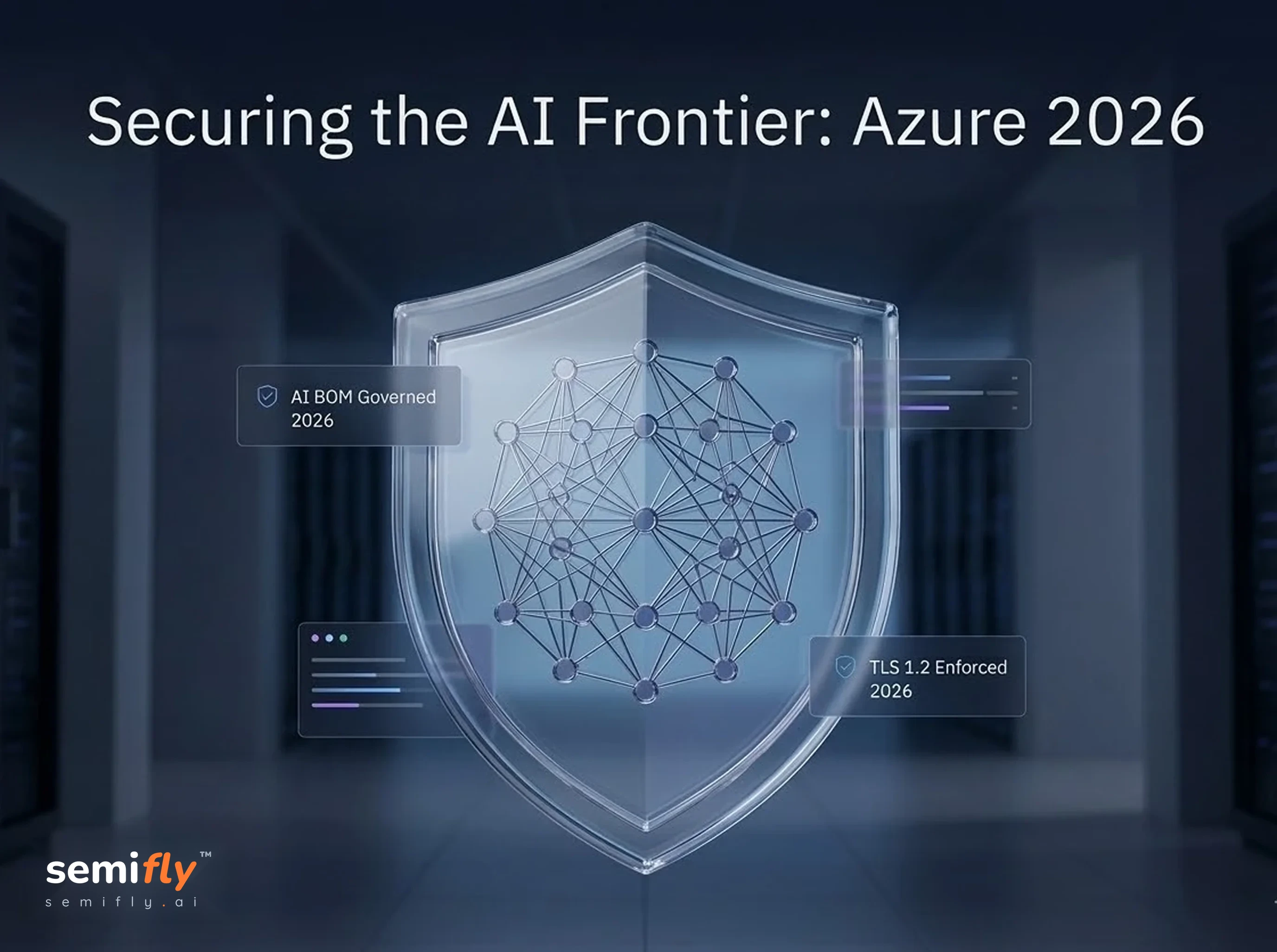
Every year the Azure platform absorbs more of the security workload that customers used to bolt on themselves. Capabilities that required third-party tooling in 2022 are now checkboxes; defaults that used to be permissive now ship hardened. For teams running production estates in Azure, the practical question is not “what did Microsoft announce” but “which defaults changed, and is our configuration still the one we think it is?”
This update walks through the themes that matter most in 2026, with an emphasis on what to actually do about each of them. It is written for the team that owns the estate—not the keynote audience.
Key Takeaways
- Identity is now unambiguously the control plane: workload identities and conditional access deserve the attention you used to give firewalls.
- Confidential computing has moved from niche to mainstream—re-price it if you dismissed it two years ago.
- Consolidated security tooling only pays off if you invest in tuning; alert fatigue migrates upstream otherwise.
- Private connectivity is becoming the assumed pattern. Public endpoints increasingly need a justification, not the other way around.
01Identity keeps moving to the center
The platform continues its long consolidation around Entra ID as the control plane for everything—human users, workload identities, and increasingly the automation and agents that act on their behalf. Two practical implications stand out.
First, legacy authentication paths keep getting narrower. Anything in your estate still using long-lived secrets, connection strings, or shared keys deserves a migration plan toward managed identities—not because the old paths stop working tomorrow, but because every platform investment (logging, anomaly detection, conditional policies) now assumes the new model. Workloads on legacy auth are progressively excluded from protections everyone else gets for free.
Second, conditional access has grown expressive enough that most organizations' policies underuse it. Risk-based conditions, device filters, and authentication-strength requirements can encode policies that used to require custom engineering. A quarterly review of policy coverage against actual sign-in telemetry is one of the highest-leverage security exercises available in Azure today—it routinely finds entire user populations or apps that quietly bypass the rules everyone assumed were universal.

02Confidential computing goes mainstream
What began as a niche capability for regulated workloads—encrypting data not just at rest and in transit but during processing—is now broadly available across mainstream VM families and container platforms. The hardware-enforced trusted execution environments that once carried painful performance and cost penalties have matured; the premium has narrowed to the point where “default to confidential for sensitive workloads” is a defensible policy rather than an aspiration.
If your compliance team has ever flagged “data in use” as a gap—or if you process regulated data in shared infrastructure and the regulator's questions are getting sharper—it is worth re-pricing confidential SKUs this year. The decision you correctly deferred in 2024 may now land the other way.
03Defender and the consolidation of signals
Microsoft's security stack continues to consolidate posture management, workload protection, and SIEM into a more unified pipeline. For lean teams this is mostly good news: fewer consoles, correlation you do not have to build, and incidents that arrive pre-assembled instead of as forty disconnected alerts.
The practical risk is assuming the defaults are your policy. Budget real engineering time for suppression rules, severity calibration, and the unglamorous work of mapping alerts to runbooks. Teams that skip this end up with a beautifully consolidated stream of notifications nobody reads—which is indistinguishable, in outcome, from having no detection at all.
04Network security defaults harden
The platform keeps nudging customers away from public endpoints. Private connectivity for PaaS services—databases, storage, key vaults—is steadily becoming the assumed pattern rather than the premium option, and new platform features increasingly assume traffic flows over private paths.
For new deployments, treat private endpoints as the default and public exposure as the exception that requires written justification. For existing estates, maintain a standing inventory of services still listening publicly; it doubles as both a security backlog and, eventually, an availability one, as older public patterns age out of support.

05What to do this quarter
- Run a policy drift review. Compare your governance baselines against what is actually deployed. Platform updates change defaults; drift accumulates silently in both directions.
- Inventory workload identities. Eliminate long-lived credentials wherever a managed identity can replace them, starting with anything that touches production data.
- Re-evaluate confidential computing. Price the SKUs against your three most sensitive workloads and let the numbers, not the 2024 assumption, decide.
- Audit public endpoints. Build the inventory, rank by data sensitivity, and schedule migrations to private connectivity.
- Tune the detection pipeline. Pick your ten noisiest alert types and either suppress them deliberately or wire them to a runbook. Repeat next quarter.
Platform security in Azure increasingly rewards teams that treat configuration as a living system rather than a launch-day checklist. The platform is doing more of the heavy lifting every year—but only for customers whose settings keep pace with it.
Ready to put this into practice?
Talk to the Semifly team about your infrastructure, security, and compliance roadmap.
Contact Us