
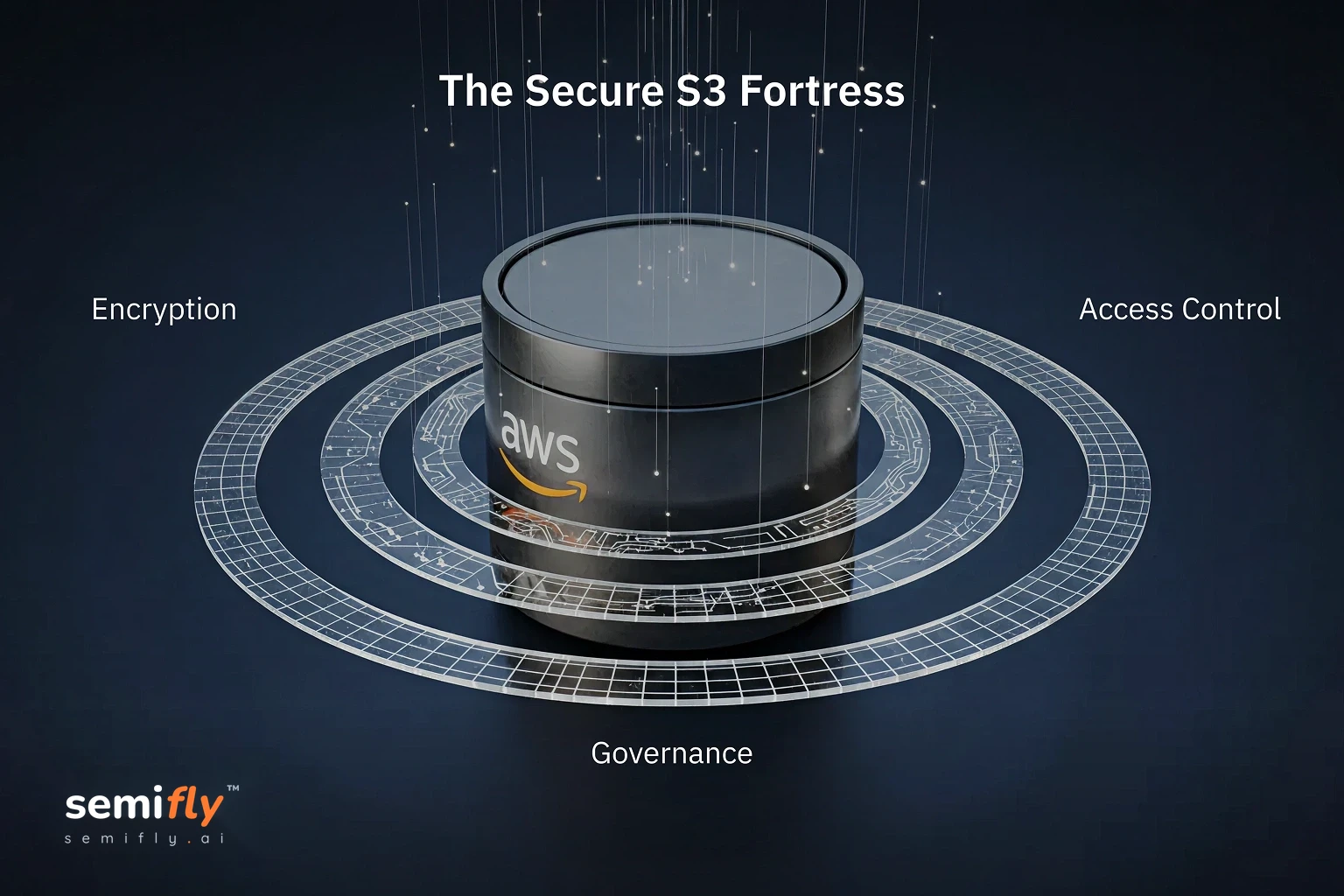
Amazon S3 looks deceptively simple: create a bucket, put objects in it, done. That simplicity is exactly why S3 is involved in so many cloud cost overruns and so many headline data exposures. The service itself is extraordinarily reliable—the failures are almost always in how it was provisioned and operated.
When you provision S3 through a service provider, you are buying their defaults and their operating discipline as much as the storage itself. The right provider makes S3 boring, inexpensive, and forgettable. The wrong one hands you a breach notification or a six-figure invoice. Here is what to examine before you sign—and the questions that separate the two.
Key Takeaways
- Security posture is non-negotiable: account-level Block Public Access, default encryption, and role-based access—no shared keys.
- Storage-class strategy should match your honest access patterns; the wrong class mix silently erases the savings.
- Lifecycle policies are mandatory from day one. Unmanaged buckets only grow.
- Egress and exit terms decide your real long-term cost—negotiate portability before signing, not after.
01Security posture before anything else
Ask precisely how buckets are provisioned. The answers should come back fast and unambiguous:
- Block Public Access enabled at the account level, not negotiated bucket by bucket. Public buckets, where genuinely required, should be deliberate, documented exceptions behind a CDN.
- Default encryption on every bucket. If your compliance regime requires customer-managed keys, confirm the provider supports KMS key policies that keep revocation in your hands.
- Access through IAM roles and bucket policies with least privilege—never shared, long-lived access keys passed around in config files.
- Posture monitoring that detects and alerts on policy drift, because the dangerous bucket is the one that was fine last quarter.
If a provider cannot articulate their answer to these in one paragraph, keep shopping. This is the part of the engagement where their defaults become your attack surface.

02Storage classes and the honesty of access patterns
S3's pricing rewards honesty about how often you touch your data. Standard for hot data, Infrequent Access for backups touched monthly, Glacier tiers for archives measured in years. The menu is straightforward; the trap is in the middle.
Infrequent Access charges retrieval fees that erase the savings if your “cold” data turns out to be lukewarm—a backup set that a restore test touches monthly, an archive that analytics quietly scans every weekend. Conversely, data parked in Standard that nobody has read since 2023 is a subsidy you are paying AWS voluntarily.
A good provider asks about access patterns before recommending a class mix—or proposes Intelligent-Tiering and lets the platform learn the pattern empirically. Ask them to model your first year across two or three realistic scenarios, including the retrieval fees. The quality of that model tells you most of what you need to know about the partnership.
03Lifecycle policies are not optional
Unmanaged buckets only grow. Insist on lifecycle rules from day one:
- Transitions to colder tiers on a defined schedule aligned with your data's actual value curve.
- Expiration of incomplete multipart uploads—a silent cost leak that almost every estate has and almost nobody has looked for.
- Version cleanup if versioning is enabled. Versioning is excellent ransomware insurance and an automatic doubling of storage cost if nobody prunes old versions.
- Deletion of data past its retention requirement—keeping everything forever is a liability policy written against yourself.
04The egress question
Storage is cheap; movement is not. Understand what you will pay when data leaves—to the internet, to another region, or to another provider. If your architecture involves regular large reads from outside AWS, egress can exceed the storage line item itself, and it is the number least likely to appear in the glossy quote.
Two questions for the provider, in writing. First: model our expected egress under realistic usage. Second: what happens contractually if we want to take our data and leave—what does the exit cost, and how long does it take? Data portability is a negotiation item before signing and a hostage situation afterward.
05Operational visibility
Finally, confirm you will be able to see what is happening once the engagement is live:
- Monitoring: storage metrics, request metrics, and cost allocation tags wired into reporting you can actually access—not a quarterly PDF.
- Auditability: access logging or CloudTrail data events enabled wherever compliance requires reconstructing who touched what, with retention that matches your audit cycle.
- Resilience: a replication strategy—same-region for durability paranoia, cross-region for disaster recovery—matched to your stated RPO rather than picked by default, and a restore test on the calendar, not in the aspirations.
S3 provisioned well disappears into the infrastructure and stays disappeared. The difference between that outcome and the expensive alternative is almost entirely in the questions you ask up front—so ask all of them.
Ready to put this into practice?
Talk to the Semifly team about your infrastructure, security, and compliance roadmap.
Contact Us