
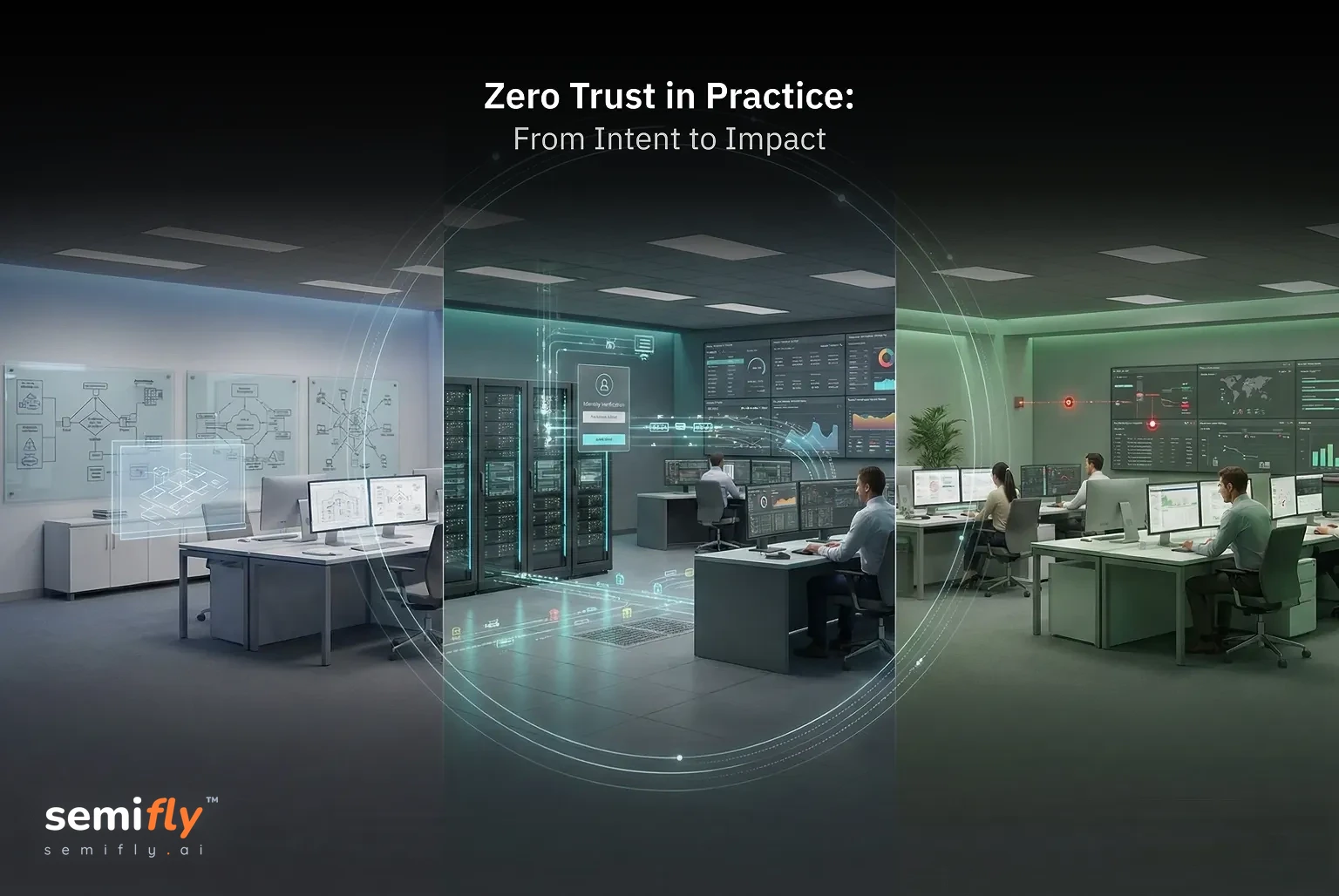
Most organizations no longer debate whether zero trust is the right security model. The perimeter-based approach—trust everything inside the firewall, inspect everything outside—collapsed the moment workloads moved to the cloud and employees started working from anywhere. The real question in 2026 is different: why do so many zero-trust programs stall after the strategy deck is approved?
The honest answer is that zero trust gets sold as an architecture when it is really an operating discipline. Architecture is a milestone; discipline is a lifestyle. This article walks through what implementation actually looks like phase by phase, why the “continuous” half of continuous protection is where programs live or die, and where a managed services partner changes the economics of the whole effort.
Key Takeaways
- Zero trust cannot be purchased as a product—it is a set of continuously enforced policies across identity, devices, and network flows.
- Successful rollouts move through three phases: visibility, enforcement in monitor mode, and progressive blocking.
- Policy drift is the silent killer: an architecture that was accurate in January is partially fiction by June without active maintenance.
- Managed services make the operational layer sustainable—24×7 monitoring, entitlement reviews, and validated controls on a contract, not on goodwill.
01Zero trust is a verb, not a noun
The core principles are easy to state. Never trust, always verify. Grant the least privilege required, for the shortest time required. Assume the breach has already happened and design so that an attacker who lands on one system cannot move laterally to the next. None of this is controversial—and none of it can be bought as a single product, despite what vendor marketing suggests.
What makes zero trust hard is that it is a continuous operating discipline. Identity policies drift as people change roles. Device posture degrades as laptops miss patches. Microsegmentation rules rot as applications are deployed, modified, and retired. Each of these is a small, individually harmless change; in aggregate they are how a hardened environment quietly becomes a permissive one.
02The three phases of implementation
Phase 1: Visibility
You cannot protect what you cannot enumerate. This phase inventories identities, devices, applications, and—critically—the actual traffic flows between them. Most organizations discover undocumented dependencies here: the finance application that quietly calls a legacy database, the service account created for a 2019 migration that still holds domain admin. The discovery alone usually justifies the effort, and it produces the dependency map that every later phase relies on.
Phase 2: Enforcement in monitor mode
Policies for identity verification, device compliance, and segmentation are written and deployed, but in a log-only posture. This surfaces the false positives that would otherwise break production on day one—the batch job that authenticates in a way your new policy considers anomalous, the executive whose ancient tablet fails every posture check. Expect several weeks of tuning. Rushing this phase is the single most common cause of failed rollouts, because the first time enforcement breaks payroll, the program loses the political capital it needs to continue.
Phase 3: Progressive enforcement
Policies flip from monitoring to blocking, starting with the lowest-risk segments and expanding outward. Each expansion is informed by the telemetry of the previous one. By the time enforcement reaches crown-jewel systems, the policy set has been validated against months of real traffic.
03Why “continuous” is the hard part
The phases above describe a project. Zero trust, however, is not a project—it is a steady state that must survive employee turnover, cloud migrations, mergers, and the next generation of attack techniques. Consider what the steady state actually demands:
- Weekly: review access analytics for anomalous authentication patterns and impossible-travel events; triage exceptions granted during the week.
- Monthly: retire stale entitlements, expire dormant accounts, and reconcile new deployments against segmentation policy.
- Quarterly: re-validate that controls block what they claim to block, and re-certify privileged access with the business owners who granted it.
- Always: respond when the monitoring stack flags credential misuse at 3 a.m.—because attackers are deliberate about working outside your business hours.
Internal teams can absolutely do this work. What they usually cannot do is keep doing it—through attrition, reorganizations, and the next urgent project that pulls the security engineer onto something else. Discipline that depends on heroics is not discipline; it is luck with a schedule.
04Where managed services fit
This operational layer is exactly where a managed services partner earns its keep. An internal team of three cannot staff a 24×7 rotation, maintain expertise across every identity provider and EDR platform, and still ship the security roadmap. A mature partner brings the runbooks, the staffing depth, and—importantly—pattern recognition from operating dozens of environments that look like yours.
- Policy lifecycle management: entitlement reviews, segmentation updates, and exception handling on a defined cadence rather than when someone remembers.
- Continuous validation: scheduled testing that verifies controls actually block what they claim to block, with findings tracked to closure.
- Incident response integration: zero-trust telemetry feeding a SOC that can act on it, not just archive it.
- Reporting that survives audits: evidence of control operation generated as a byproduct of operations—which your next compliance cycle will thank you for.
05Getting started
If your zero-trust initiative has stalled, resist the urge to buy another tool. Start with a two-week assessment of where your identities, devices, and flows actually stand against the policies you have already written. The gap between the two is your real roadmap. Then decide—honestly—who is going to close that gap every week for the next five years. Answering that question well is the difference between a zero-trust strategy and zero-trust protection.
Ready to put this into practice?
Talk to the Semifly team about your infrastructure, security, and compliance roadmap.
Contact Us