Data centers change slowly and then all at once. For a decade the story was consolidation into the cloud; the current chapter is more interesting—densities climbing past what legacy rooms can cool, sustainability moving from press release to procurement criterion, workloads migrating toward the edge, and a hybrid settlement replacing the all-cloud absolutism. Companies that read these shifts early make cheaper decisions for the next ten years of compute.
Key Takeaways
- Rack density is the forcing function: accelerated computing pushes power-per-rack beyond legacy design assumptions.
- Sustainability metrics (PUE, carbon, water) are entering RFPs and regulation—efficiency is now a compliance and cost story.
- Edge deployment grows wherever latency, bandwidth, or data gravity make the round trip unaffordable.
- Hybrid is the settlement: workloads sorted by economics and physics, not ideology.
01Density changes everything upstream
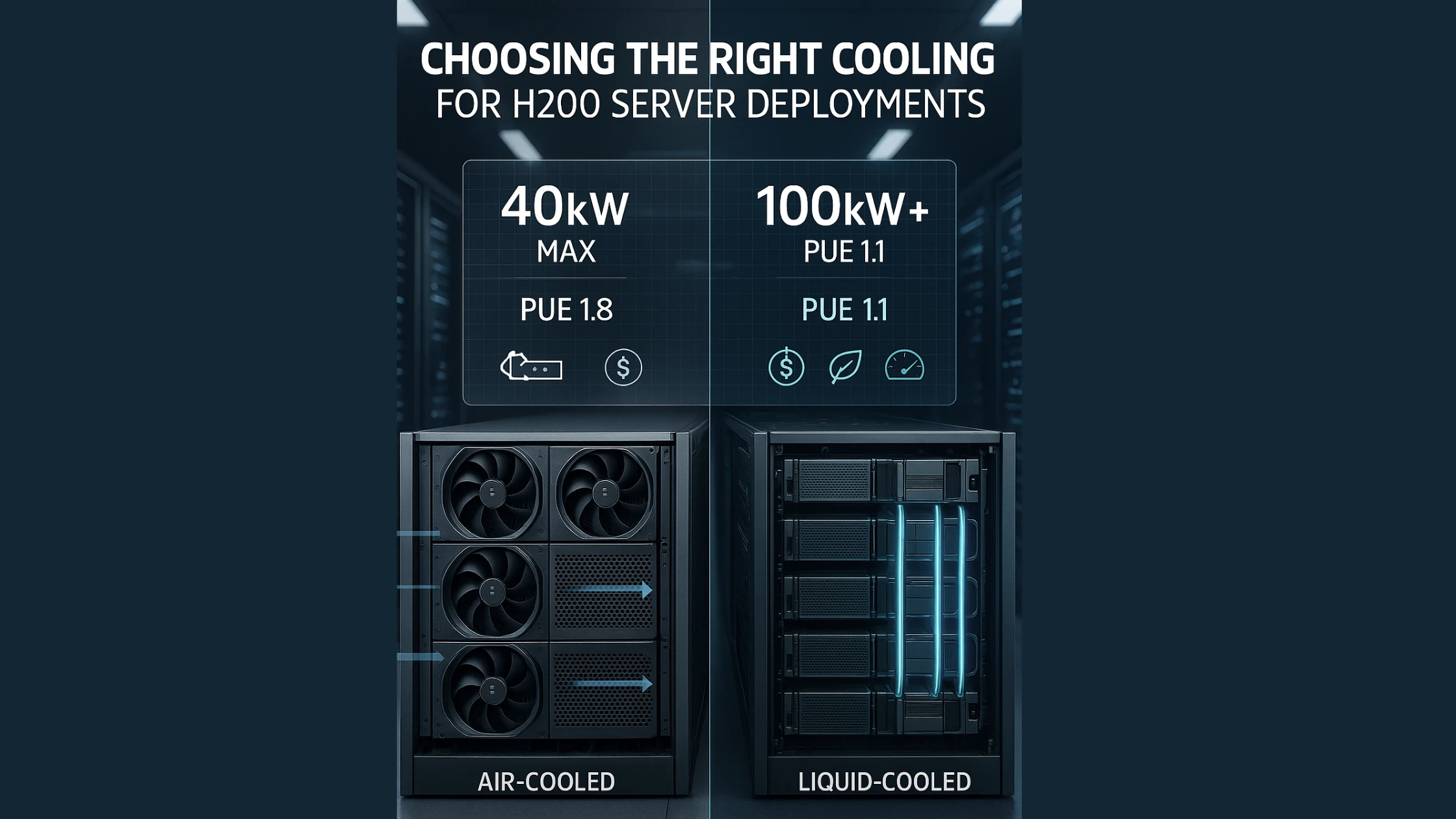
The arrival of accelerated computing—GPU clusters for AI, high-core-count everything—has pushed design targets from the old 5–10kW per rack toward 30, 60, and beyond. That single number cascades: power distribution upgrades, containment and liquid cooling, floor loading, and a widening gap between facilities built last decade and the workloads companies want to run this one. The practical consequence for most enterprises is a make-or-partner decision: retrofit owned rooms, or place dense workloads with colocation and hosting partners who built for it.
02Sustainability stops being optional
Energy efficiency (PUE), carbon accounting, water usage, and heat-reuse schemes have moved from marketing to mechanics: regulators are asking, large customers are scoring suppliers on it, and energy prices made efficiency self-funding. Expect facility selection—owned or partnered—to weigh renewable supply, modern cooling, and reporting capability the way it once weighed only price and latency.
03The edge fills in
Centralization wins on cost until physics objects. Manufacturing telemetry, retail systems, video analytics, and latency-sensitive services increasingly justify small compute footprints close to where data originates—micro data centers, smart-building closets, regional colo. The pattern is not cloud versus edge; it is a hierarchy: process locally what must be fast or cheap to move, centralize what benefits from scale.
04The hybrid settlement
- Cloud for elasticity, managed services, and global reach.
- Colocation/hosting for dense, steady, sovereignty-sensitive, or economically cloud-hostile workloads.
- Edge for the latency-bound and bandwidth-heavy.
- The connective tissue—networking, identity, observability spanning all three—is where architecture effort now concentrates.
05What to do with this
Audit your portfolio against these curves: which workloads are density-bound, which are latency-bound, which face sustainability scrutiny, and which sit in cloud tiers that economics no longer justify. The companies handling these shifts well are not predicting the future precisely—they are keeping their options open with partners and architectures that can move workloads when the curves say so.
Ready to put this into practice?
Talk to the Semifly team about your infrastructure, security, and compliance roadmap.
Contact Us