On paper the DGX H200 and DGX H100 look like siblings: same Hopper GPU architecture, same 8-GPU chassis, same NVLink fabric. The difference is concentrated in one subsystem—memory—and that concentration is exactly why benchmark results between the two systems are so workload-dependent. Understanding which of your workloads live in the memory-bound regime is the whole game when deciding between them.
Key Takeaways
- The H200's headline upgrade is memory: 141GB of HBM3e per GPU at roughly 4.8TB/s, versus 80GB at 3.35TB/s on the H100.
- Compute throughput is essentially unchanged—compute-bound workloads see modest gains.
- Memory-bound workloads—LLM inference with long contexts, large batch serving, big embedding tables—see the dramatic improvements.
- Fewer nodes reaching the same model size changes the enterprise math more than per-GPU speedups do.
01What actually changed
Per GPU, the H200 carries 141GB of HBM3e against the H100's 80GB of HBM3—76% more capacity—with memory bandwidth rising from roughly 3.35TB/s to 4.8TB/s. Across an 8-GPU DGX node, aggregate GPU memory jumps past the symbolic 1TB mark. Compute specifications, meanwhile, are essentially carried over.
That asymmetry writes the benchmark story in advance: anywhere the H100 spent cycles waiting on memory, the H200 pulls ahead; anywhere the H100 was compute-saturated, the two systems finish nearly together.
02Reading the benchmarks like an adult
Vendor benchmark charts cluster around large-model inference because that is where the memory upgrade shines: long context windows, fat KV caches, and high-batch serving are bandwidth-and-capacity workloads. Gains there are real and frequently dramatic—the difference between a 70B-parameter model that fits comfortably with headroom for batching versus one squeezed across more silicon.
Training tells a more nuanced story. Pre-training throughput on dense models improves modestly. The bigger training win is practical: larger micro-batches and fewer pipeline-parallel stages fit per node, which simplifies parallelism strategy and improves cluster efficiency—an effect that shows up in time-to-convergence and engineering hours more than in a single-node benchmark.
03Enterprise implications
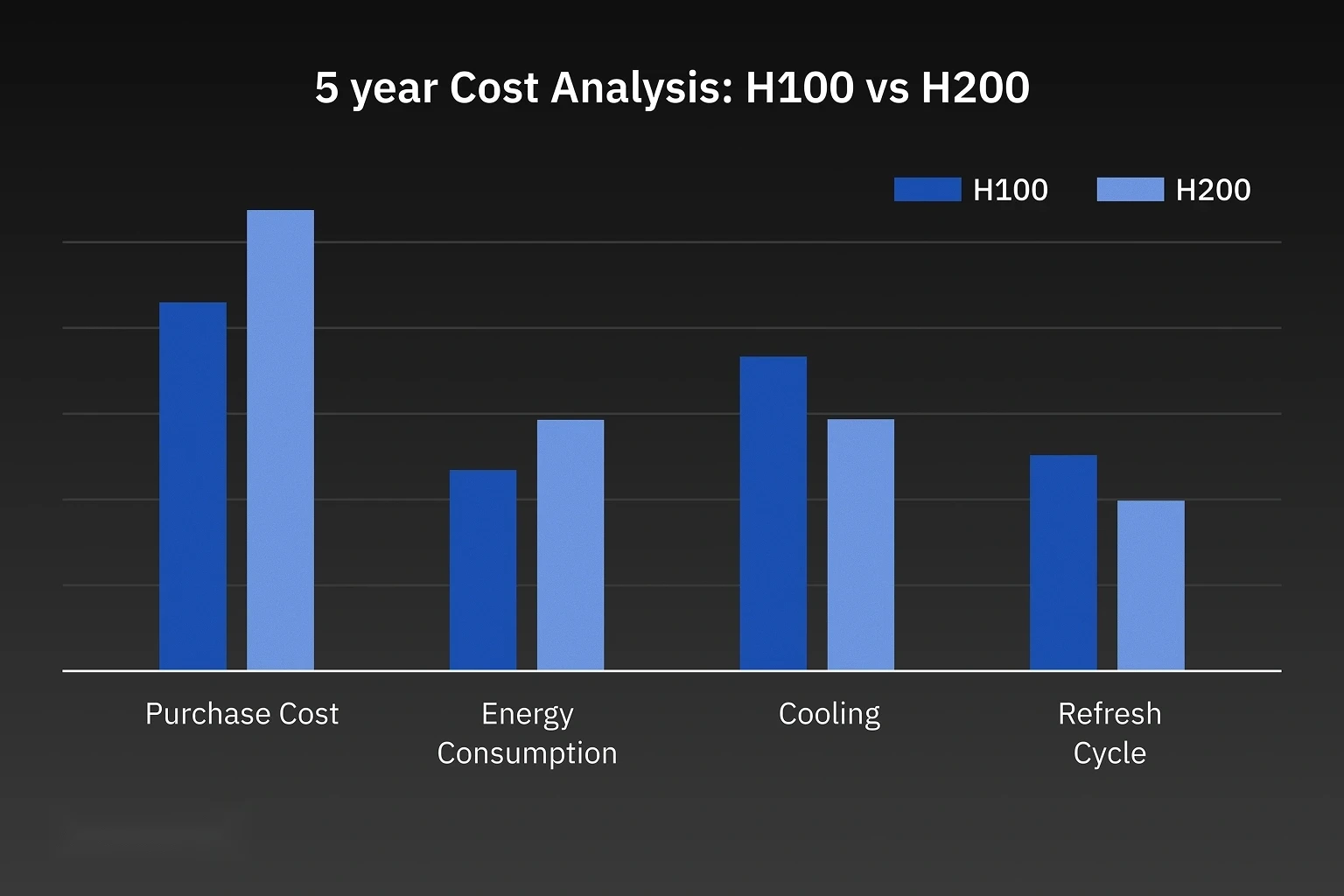
- Consolidation: models that required two H100 nodes can fit on one H200 node—halving the fabric complexity, failure surface, and power draw for that workload.
- Inference economics: more concurrent sessions and longer contexts per GPU translate directly into cost-per-token improvements for serving fleets.
- Fleet strategy: mixed fleets work well—route memory-hungry serving to H200 nodes and keep compute-bound training on H100s rather than paying the premium everywhere.
- Future-proofing: context lengths and model sizes only move one direction. The capacity headroom is insurance with a clear expiry behavior—it gets consumed.
04The decision in one paragraph
Profile your workloads. If GPU memory utilization pins at capacity while compute sits underutilized—the signature of modern LLM serving—the DGX H200 pays for its premium quickly. If your fleet runs compute-saturated dense training, the H100 remains excellent value, and the right benchmark to study is your own profiler output, not anyone's marketing chart.
Ready to put this into practice?
Talk to the Semifly team about your infrastructure, security, and compliance roadmap.
Contact Us